 Rummy Skill
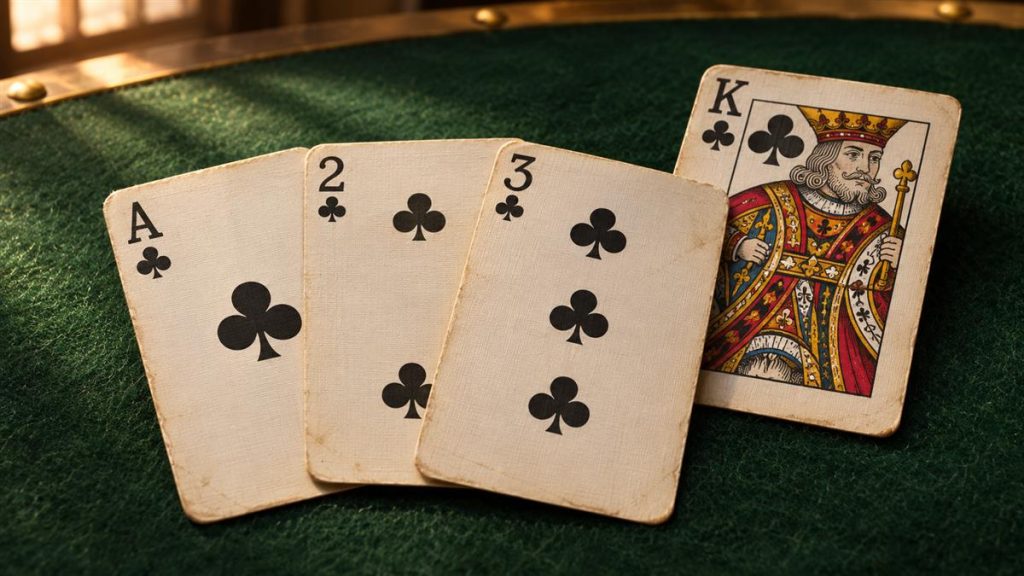
An ace between a king and a two looks connected. Lay out the suit in both directions before choosing your draw.
Consider four clubs in your hand: K♣, A♣, 2♣ and 3♣. In a game that allows an ace at either end of a sequence, three of these cards already make a pure run. Which one is loose?
Give the ace one end of the row
Place A♣ to the left of 2♣, then put 3♣ after it. The king stays outside. Moving the king beside the ace does not give you a four-card run. You would have crossed from king to ace to two, a wrap that the rules in this exercise do not allow.
Work through two possible draws
Draw 4♣ and your low run extends to four cards. Draw Q♣ instead and you have a choice. Q♣–K♣–A♣ is complete, but 2♣–3♣ needs another card. Keep the low run for the moment if, for example, Q♣ can join Q♥ and Q♦ elsewhere. That arrangement finishes both the low clubs and the queens.
For a quick table drill, cover the ace with your finger. Look at Q♣–K♣ on one side and 2♣–3♣ on the other. Pick where the ace does the most work, then recount the cards left outside.
Rules reference · Pagat’s Indian Rummy rules.