 Rummy Skill
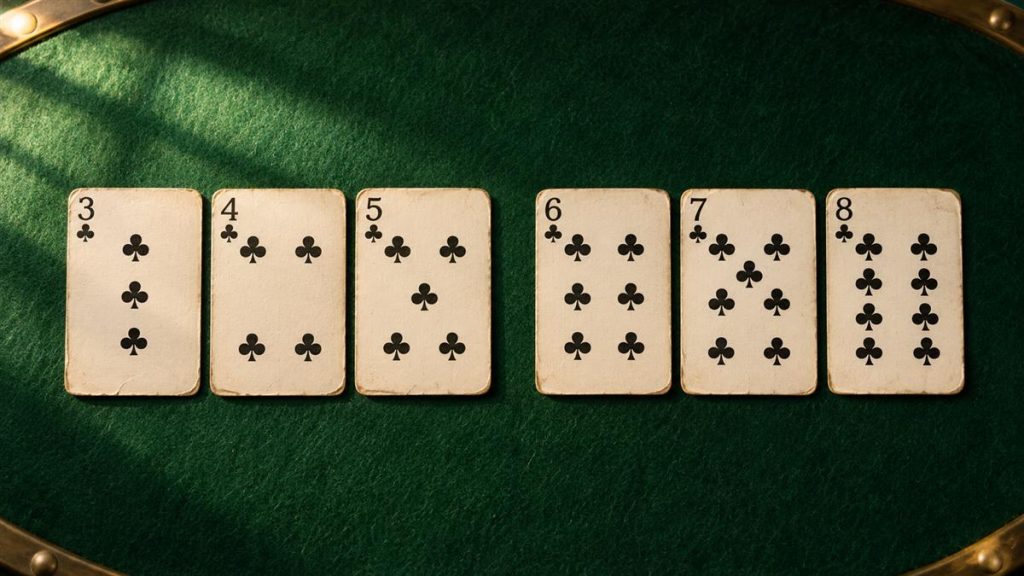
Lay out six consecutive clubs, then remove one card to find the exact limit of the split.
Fan out 3♣–4♣–5♣–6♣–7♣–8♣. You can arrange them as one long pure run. If your table accepts separate three-card runs and your hand needs a second sequence, slide a finger between 5♣ and 6♣.
Count both sides of the break
The left side reads 3♣–4♣–5♣. The right reads 6♣–7♣–8♣. Each group has three consecutive cards of its own, and neither borrows a card from the other. If the rest of your hand contains four kings of different suits and three sevens of different suits outside clubs, the two runs and two sets cover all thirteen cards.
Try the same move with five clubs
Take away 8♣. You can still point to two runs on paper: 3♣–4♣–5♣ and 5♣–6♣–7♣. On the table you have only one 5♣. Physically shifting it into the first group leaves two cards on the right. A draw of either 2♣ or 8♣ would restore the six consecutive cards needed for this split.
Check the declaration requirements for the game you are playing. A house rule requiring a four-card sequence changes whether two groups of three will satisfy the hand.
Rules reference · Rummy.com’s illustrated rules and card values.